Argan Oil for Hair: What It Is and How to Use It in Your Routine
By Shiny Leaf Team · November 4, 2018
Argan oil earned the nickname "liquid gold" for its color, but it stuck around because of how hair feels after a few drops: soft, smooth and easy to comb. Here's what it actually is, and the four simplest ways to use it.
No miracle language, just a practical guide to a classic hair oil, where it fits in a wash-day routine, and how to pair it with the conditioner you already use.
What is argan oil?
Argan oil is pressed from the kernels of the argan tree, which grows almost exclusively in southwestern Morocco. The kernels sit inside a hard nut, inside a fleshy fruit, and getting to them is slow work, which is part of why the finished oil has always carried a premium price and a premium reputation.
In the bottle it's a pale golden oil with a light, slightly nutty scent. The cosmetic grade used for hair is typically cold-pressed and either unscented or lightly fragranced. If you see "Argania spinosa kernel oil" on an ingredient list, that's argan.
One tree, one region, one slow process. That's why a small bottle feels like a small luxury.
What's in it, and why does hair feel different afterwards?
Argan oil is mostly fatty acids, chiefly oleic and linoleic acid, along with naturally occurring vitamin E. That's the whole story, and it's enough.
Oils like this sit on the outside of the hair strand in a light film. That film is what you feel: less friction when you comb, a smoother surface that reflects light (that's the shine), and ends that lie flat instead of fluffing up. Argan is lighter than coconut or castor oil, so it does this without making fine hair feel heavy, as long as you don't overdo the amount.
A drop or two on the comb is often all the lengths need.
How do you use argan oil on hair?
Four ways, from the lightest touch to the most indulgent. Start small; you can always add a drop.
1. As a finishing oil on damp ends. After washing, towel-dry, then rub two or three drops between your palms and smooth them over the mid-lengths and ends. Keep it off the roots. This is the everyday use and the one most people stick with.
2. On dry ends between washes. A single drop, warmed in your hands, pressed into the last few inches of hair on day two or three. It tames the fluff and brings the shine back without a rewash.
3. As a pre-wash oil. Twenty minutes before you shower, work a teaspoon (less for short hair) through the lengths, not the scalp. Then shampoo as normal, scalp first, and condition. The oil keeps the lengths feeling soft while the shampoo does its job up top.
4. Mixed into your conditioner. Add a few drops to your usual handful of conditioner for a richer, slip-heavy rinse. Leave it on for 2–3 minutes, then rinse until hair feels smooth, not slippery.
Ends, not roots. Drops, not pumps. Argan oil rewards restraint.
How much argan oil is too much?
More than you think. The most common complaint about hair oils is greasy, limp hair, and it's almost always a dosing problem.
A rough guide: two to three drops for fine or short hair, four to six for thick or long hair, and a teaspoon only for a pre-wash soak you're about to rinse out. If your hair looks wet an hour later, halve the amount next time. If your scalp gets oily quickly, keep the oil off it entirely and let your shampoo and conditioner handle the top.
Where does it fit with shampoo and conditioner?
Argan oil is a finishing touch, not a replacement. The daily work is still done in the shower: a shampoo that cleans the scalp and a conditioner that softens the lengths.
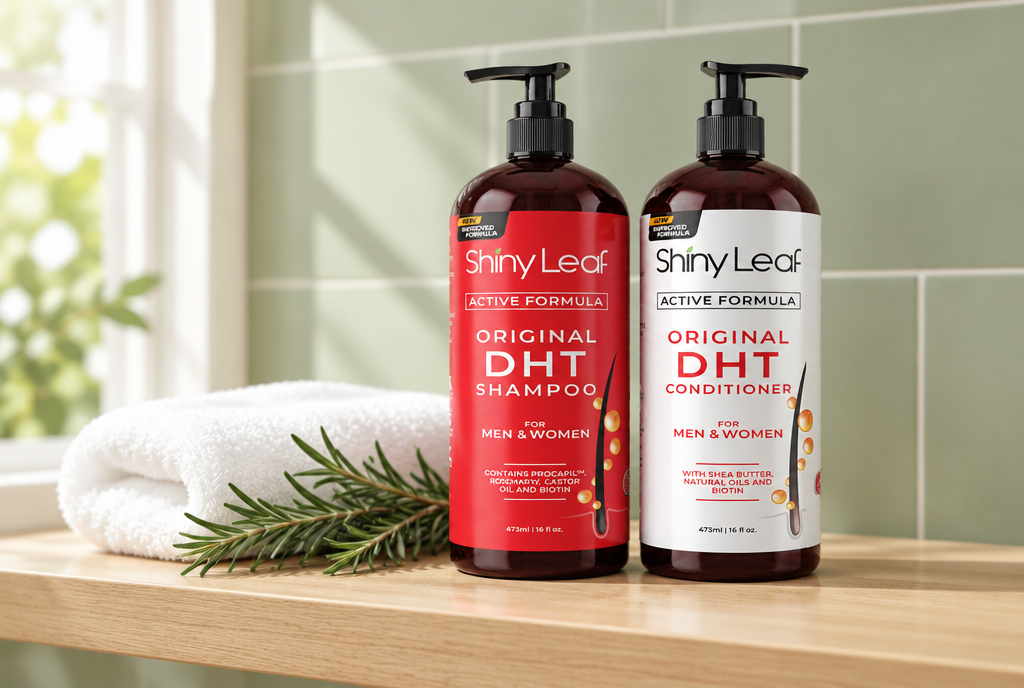
If you like the feel oils give your hair, look for a conditioner that already carries a few. Our Original DHT Conditioner is made with organic shea butter, avocado oil, castor oil and rosemary oil alongside biotin and hydrolyzed keratin with silk amino acids, and it's labeled paraben-free and color-safe. Follow it with a drop of argan on the ends and you have a full routine in three steps. You'll find it and its sister formulas in our conditioner collection.
Conditioner in the shower, a drop of argan after. The oil finishes what the conditioner starts.
The argan wash-day card
1Optional: a teaspoon of argan through the lengths 20 minutes before showering.
2Shampoo the scalp, leave on 2–3 minutes, rinse.
3Conditioner from mid-length to ends, 2–3 minutes, rinse until smooth.
4Towel-dry, then 2–3 drops of argan on damp ends.
5Between washes: one drop on dry ends if they fluff.
How do you pick a good bottle of argan oil?
Three label checks. First, the ingredient list should be one line long: "Argania spinosa kernel oil," possibly with a fragrance or vitamin E listed after it. Second, it should come in a dark glass bottle with a dropper, which keeps the oil fresh and the dosing small. Third, trust your nose: pure argan smells faintly nutty, not rancid or perfumed over.
Store it out of direct sun and use it within the time printed on the bottle. A 30 ml dropper bottle at two or three drops a day lasts months.
One ingredient, dark glass, a dropper. If the label needs more than a line, keep looking.
Frequently asked questions
Can I put argan oil on my scalp?
You can, but most people get the feel they want from the lengths and ends alone. If your scalp is on the oily side, keep the oil off it and let your shampoo do the scalp work.
Can I use argan oil every day?
Yes, in small amounts. A drop or two on the ends daily is the most common way to use it.
Is argan oil good for fine hair?
It's one of the lighter hair oils, which is why it's a favorite for fine hair. Start with two drops on damp ends and adjust.
Does argan oil replace conditioner?
No. Conditioner softens and detangles in the shower; argan oil is a finishing step afterwards. Together they make a simple three-step routine.
Can I mix argan oil into Shiny Leaf conditioner?
Yes. A few drops stirred into your usual amount of conditioner gives a richer rinse. Leave it on for 2–3 minutes and rinse until hair feels smooth.

 The complete post-op hair kit
 Your daily routine
 DHT Pro Set
 The 90-day routine

 Bariatric bestsellers
 The 90-day hair routine


 Shop the routineOriginal DHT Conditioner$21.95
Shop now